
" height="20.5755px" id="mdSXxnMtE" width="18px"/></svg>)
05 Dec 2025
Hopescrolling
Long gone are the days where watching the news and catching up with friends were scheduled moments in our daily routines.
Long gone are the days where watching the news and catching up with friends were scheduled moments
in our daily routines.
In the digital area of competition for attention, we are connected 24/7. We’re not only constantly wired to everything going wrong with the world but also to everything going right with our friends’ lives, and in the process we also tune in to strangers online finding new ways to overexpose themselves.
In the digital area of competition for attention,
we are connected 24/7. We’re not only constantly wired to everything going wrong with the world but also to everything going right with our friends’ lives, and in the process we also tune in to strangers online finding new ways to overexpose themselves.
In the digital area of competition for attention, we are connected 24/7. We’re not only constantly wired to everything going wrong with the world but also
to everything going right with our friends’ lives, and in the process we also tune in to strangers online finding new ways to overexpose themselves.
Who hasn’t opened social media instinctively and accidentally spent
3 hours watching toxic content and been left feeling anxious, empty and like we’ve wasted another evening?
But things might be starting to change. Doomscrolling fatigue has reached
a point where people have decided they need to do something about it.
Hopescrolling
Google “hopescrolling” or “bloomscrolling”, and you’ll find a flood of guides for how to train your algorithm to feed you positive vibes rather than fake, sensationalist and clickbait content (like this article
on Forbes).
Hopescrolling goes beyond changing the way you use mainstream apps.
The rise in apps and platforms that offer an escape from doomscrolling
is an obvious signal that there
is a demand for alternative forms
of being entertained and informed
and interacting online. The Fediverse
is a network of separate social media sites that are able to communicate with one another due to their shared open communication protocols (examples:
Pixelfed, Mastodon, Lemmy, PeerTube, Friendica). The momentum behind these platforms signals that people are actively searching for places where discovery is determined by choice, community, and common interests rather than by secretive algorithms.
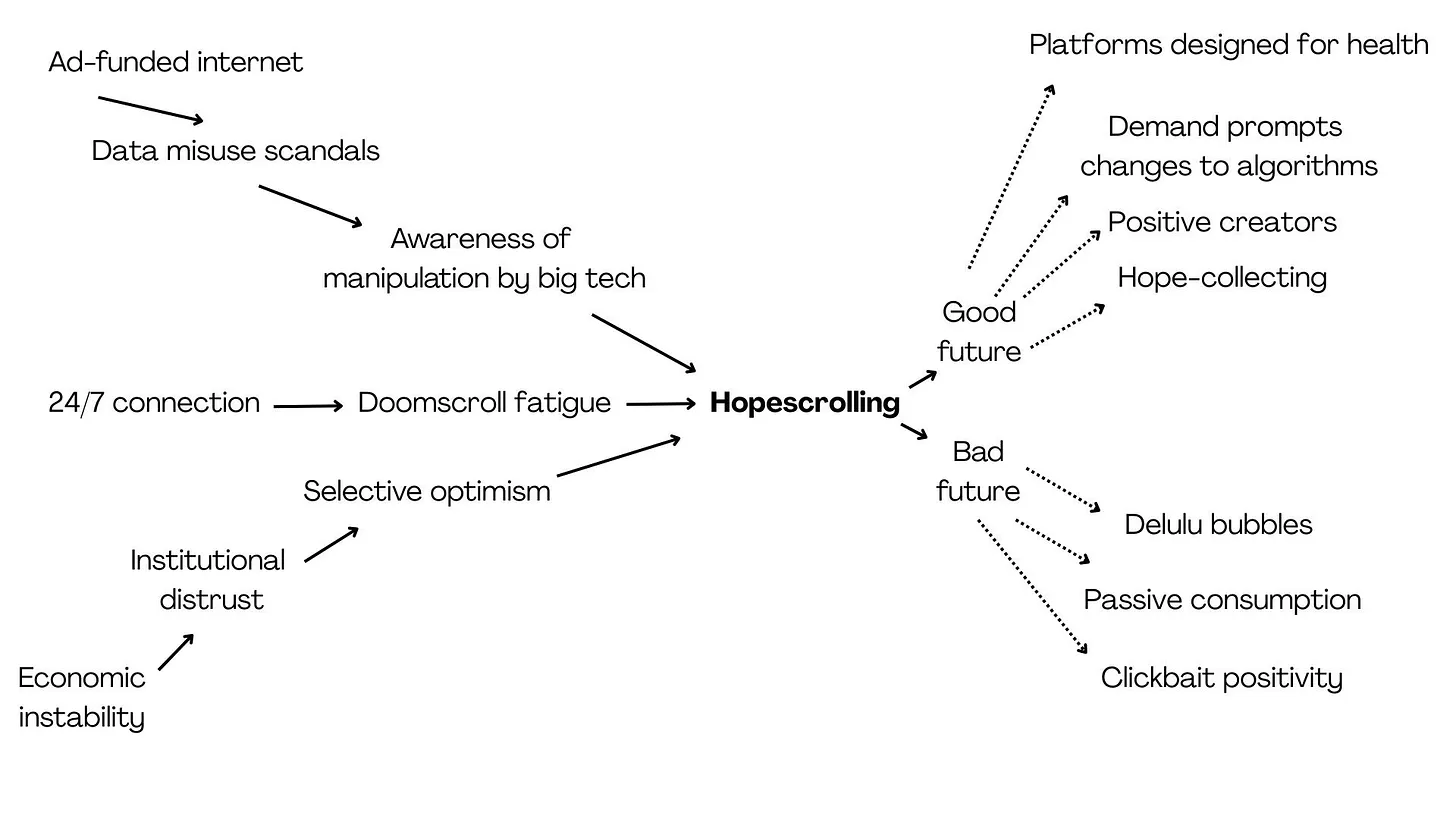
Apart from doomscroll fatigue, people have reasons to be looking for alternatives. One scandal after another about data misuse
has led to growing awareness of how big tech manipulates our information and our opinions. Also, after decades of political instability and economic inequality, we are losing institutional trust. The need for more feel-good content is perhaps a form of selective optimism. It’s escapism, but it’s also resistance.
Going offline
Some people take resistance one step further by trying to be offline more often. Doomscrolling is just part of the bigger picture of the broader problem of digital fatigue. Since the widespread adoption of smartphones in the late 2000s, we’ve had certain connectivity expectations from work and social life. Add that to an economic model prioritising ad revenue and the algorithms optimised
for addiction that resulted from it, and you’ve got the perfect storm for digital burnout.
People are now disabling notifications, buying dumbphones,
planning digital detoxes and downloading apps to meet offline (like Meetup or Timeleft) and apps that limit their screen time (like StayFree).
Feeds Out, Communities In
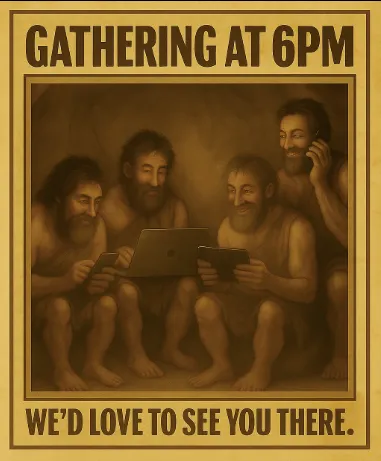
People always needed communities. Early humans lived in small hunter-gatherer bands. Neighbourhood clubs replaced bands; fanfiction groups replaced neighbourhood clubs.
The current online world with its feeds designed for addiction was lacking this kind of intimate, interest-driven space.
Who hasn’t opened social media instinctively and accidentally spent 3 hours watching toxic content and been left feeling anxious, empty and like we’ve wasted another evening? But things might be starting to change. Doomscrolling fatigue has reached
a point where people have decided they need to do something about it.
Hopescrolling
Google “hopescrolling” or “bloomscrolling”, and you’ll find a flood of guides for how to train your algorithm to feed you positive vibes rather than fake, sensationalist and clickbait content (like this article on Forbes).
Hopescrolling goes beyond changing the way you use mainstream apps. The rise in apps and platforms that offer an escape from doomscrolling is an obvious signal that there is a demand for alternative forms of being entertained and informed and interacting online. The Fediverse is a network of separate social media sites that are able to communicate with one another due to their shared open communication protocols (examples: Pixelfed, Mastodon, Lemmy, PeerTube, Friendica). The momentum behind these platforms signals that people are actively searching for places where discovery is determined by choice, community, and common interests rather than by secretive algorithms.
Apart from doomscroll fatigue, people have reasons to be looking for alternatives. One scandal after another about data misuse has led to growing awareness of how big tech manipulates our information and our opinions. Also, after decades of political instability and economic inequality, we are losing institutional trust. The need for more feel-good content is perhaps a form of selective optimism. It’s escapism, but it’s also resistance.
Going offline
Some people take resistance one step further by trying to be offline more often. Doomscrolling is just part of the bigger picture of the broader problem of digital fatigue. Since the widespread adoption of smartphones in the late 2000s, we’ve had certain connectivity expectations from work and social life. Add that to an economic model prioritising ad revenue and the algorithms optimised for addiction that resulted from it, and you’ve got the perfect storm for digital burnout.
People are now disabling notifications, buying dumbphones, planning digital detoxes and downloading apps to meet offline (like Meetup or Timeleft) and apps that limit their screen time (like StayFree).
Feeds Out, Communities In
People always needed communities. Early humans lived in small hunter-gatherer bands. Neighbourhood clubs replaced bands; fanfiction groups replaced neighbourhood clubs. The current online world with its feeds designed for addiction was lacking this kind of intimate, interest-driven space.
Who hasn’t opened social media instinctively and accidentally spent 3 hours watching toxic content and been left feeling anxious, empty and like we’ve wasted another evening? But things might be starting to change. Doomscrolling fatigue has reached
a point where people have decided they need to do something about it.
Hopescrolling
Google “hopescrolling” or “bloomscrolling”, and you’ll find a flood of guides for how to train your algorithm to feed you positive vibes rather than fake, sensationalist and clickbait content (like this article on Forbes).
Hopescrolling goes beyond changing the way you use mainstream apps. The rise in apps and platforms that offer an escape from doomscrolling is an obvious signal that there is a demand
for alternative forms of being entertained and informed
and interacting online. The Fediverse is a network of separate social media sites that are able to communicate with one another due to their shared open communication protocols (examples:
Pixelfed, Mastodon, Lemmy, PeerTube, Friendica). The momentum behind these platforms signals that people are actively searching for places where discovery is determined by choice, community, and common interests rather than by secretive algorithms.
Apart from doomscroll fatigue, people have reasons to be looking for alternatives. One scandal after another about data misuse
has led to growing awareness of how big tech manipulates our information and our opinions. Also, after decades of political instability and economic inequality, we are losing institutional trust. The need for more feel-good content is perhaps a form of selective optimism. It’s escapism, but it’s also resistance.
Going offline
Some people take resistance one step further by trying to be offline more often. Doomscrolling is just part of the bigger picture of the broader problem of digital fatigue. Since the widespread adoption of smartphones in the late 2000s, we’ve had certain connectivity expectations from work and social life. Add that to an economic model prioritising ad revenue and the algorithms optimised
for addiction that resulted from it, and you’ve got the perfect storm for digital burnout.
People are now disabling notifications, buying dumbphones,
planning digital detoxes and downloading apps to meet offline (like Meetup or Timeleft) and apps that limit their screen time (like StayFree).
Feeds Out, Communities In
People always needed communities. Early humans lived in small hunter-gatherer bands. Neighbourhood clubs replaced bands; fanfiction groups replaced neighbourhood clubs. The current online world with its feeds designed for addiction was lacking this kind
of intimate, interest-driven space.
Discord has over 259 million monthly active users, up from approximately 198 million in 2023. Reddit has 108 million active daily, and the Fediverse platforms mentioned above, which often put niche communities at the centre, are becoming more and more popular.
Change is also happening in mainstream social media, with platforms adding or emphasising community features.
Threads recently introduced a “communities” feature, and YouTube and X have made changes to theirs this year.
Post-slop AI
Post-gpt4/ diffusion 3 breakthroughs have elevated the creative ceiling, and the AI race has led to price drops, which ultimately resulted in a democratisation of tools. At the same time, because of this, there was a boom in AI slop,
and discussions about it flooding our feeds are abundant. What doesn’t get talked about enough is the high-quality art that is being produced in collaboration with AI across disciplines like music, film, and writing.
AI music is a whole rabbit hole on YouTube. The same channels often post tracks that undoubtedly sound fake and others that you can genuinely listen to on repeat. There is a “cover” of a Harry Styles song that has become part of my playlist.
Discord has over 259 million monthly active users, up from approximately 198 million in 2023. Reddit has 108 million active daily, and the Fediverse platforms mentioned above, which often put niche communities at the centre, are becoming more and more popular.
Change is also happening in mainstream social media,
with platforms adding or emphasising community features.
Threads recently introduced a “communities” feature, and YouTube and X have made changes to theirs this year.
Post-slop AI
Post-gpt4/ diffusion 3 breakthroughs have elevated the creative ceiling, and the AI race has led to price drops, which ultimately resulted in a democratisation of tools. At the same time, because
of this, there was a boom in AI slop, and discussions about it flooding our feeds are abundant. What doesn’t get talked about enough is the high-quality art that is being produced
in collaboration with AI across disciplines like music, film,
and writing.
AI music is a whole rabbit hole on YouTube. The same channels often post tracks that undoubtedly sound fake and others that you can genuinely listen to on repeat. There is a “cover” of a Harry Styles song that has become part of my playlist.
Discord has over 259 million monthly active users, up from approximately 198 million in 2023. Reddit has 108 million active daily, and the Fediverse platforms mentioned above, which often put niche communities at the centre, are becoming more and more popular.
Change is also happening in ainstream social media, with platforms adding
or emphasising community features.
Threads recently introduced
a “communities” feature, and YouTube and X have made changes to theirs this year.
Post-slop AI
Post-gpt4/ diffusion 3 breakthroughs have elevated the creative ceiling, and the AI race has led to price drops, which ultimately resulted in a democratisation of tools. At the same time, because
of this, there was a boom in AI slop, and discussions about it flooding our feeds are abundant. What doesn’t get talked about enough is the high-quality art that is being produced
in collaboration with AI across disciplines like music, film,
and writing.
AI music is a whole rabbit hole on YouTube. The same channels often post tracks that undoubtedly sound fake and others that you can genuinely listen to on repeat. There is a “cover”
of a Harry Styles song that has become part of my playlist.

AI film has become a genre, perhaps a new art form in itself. Curious Refuge is an online school that started as a YouTube channel that trains professionals and aficionados in the craft. Programmes like theirs have fuelled an AI film festival boom.
Marie Dollé from In Bed With Social talks about an “AI glow”, observable in some pieces written by young, inexperienced authors who are nevertheless masterful at using technology to adopt a “professional maturity they have not yet had time to acquire.”
“(...) Driven by a sharp mind, an agile brain, someone intelligent who mobilizes concepts, references, and argumentative structures they have not yet had time to test or digest through lived experience, but who has enough finesse to select them, shape them, even extend them.”
This article, the one you’re reading, was made possible by a very long conversation with an LLM. I hope I gave it a glow.
Futures
Let’s imagine for a second, for fun, all that can possibly go wrong if these trends keep trending. When it comes to AI and creativity, visions of artistic differentiation collapsing, audiences becoming numb to novelty and artistic mastery concentrating around a new elite haunt me. If people want to be more offline, the internet might die with AI overtaking human participation (all there will be left is bots talking to each other).
I see bubbles. Micro-demographics living in optimistic hopescrolling bubbles and substituting action for passive feel-good consumption of monetised, clickbait sensational positivity. Extremist bubbles multiplying in the new closed communities. Brands infiltrating the ok-bubbles and commercialising communities. I see deregulation of ad targeting vs. communities. I see a hierarchy of gated communities, and I don’t like it.
But things don’t need to go that way. On the optimistic front, we could contemplate that the demand will prompt changes from corporations to their products. They could change the algorithms for the better. Platforms and devices could be designed for health. Creators could pick up on people’s craving for positivity and produce content accordingly. The trend could go from content to form: imagine hope-collecting instead of hopescrolling. Offline time could become so normalised even your boss starts respecting it. Online communities could lead to the creation of fourth spaces. With AI, taste can become the new talent, new movements and genres can emerge, and art production can be democratised.
AI film has become a genre, perhaps a new art form
in itself. Curious Refuge is an online school that started as a YouTube channel that trains professionals and aficionados in the craft. Programmes like theirs have fuelled an AI film festival boom.
Marie Dollé from In Bed With Social talks about an “AI glow”, observable in some pieces written by young, inexperienced authors who are nevertheless masterful at using technology to adopt
a “professional maturity they have not yet had time to acquire.”
“(...) Driven by a sharp mind, an agile brain, someone intelligent who mobilizes concepts, references, and argumentative structures they have not yet had time to test or digest through lived experience, but who has enough finesse to select them, shape them, even extend them.”
This article, the one you’re reading, was made possible by a very long conversation with an LLM. I hope I gave it a glow.
Futures
Let’s imagine for a second, for fun, all that can possibly go wrong
if these trends keep trending. When it comes to AI and creativity, visions of artistic differentiation collapsing, audiences becoming numb to novelty and artistic mastery concentrating around a new elite haunt me. If people want to be more offline, the internet might die with AI overtaking human participation (all there will be left
is bots talking to each other).
I see bubbles. Micro-demographics living in optimistic hopescrolling bubbles and substituting action for passive feel-good consumption of monetised, clickbait sensational positivity. Extremist bubbles multiplying in the new closed communities. Brands infiltrating the ok-bubbles and commercialising communities. I see deregulation of ad targeting vs. communities.
I see a hierarchy of gated communities, and I don’t like it.
But things don’t need to go that way. On the optimistic front,
we could contemplate that the demand will prompt changes from corporations to their products. They could change the algorithms for the better. Platforms and devices could be designed for health. Creators could pick up on people’s craving for positivity and produce content accordingly. The trend could go from content
to form: imagine hope-collecting instead of hopescrolling. Offline time could become so normalised even your boss starts respecting it. Online communities could lead to the creation of fourth spaces. With AI, taste can become the new talent, new movements and genres can emerge, and art production can be democratised.
Technology can either trap us in loops of passive consumption or empower us to connect, create, and care. These networks could become cages or canvases. The choice isn’t just in the hands of platforms or algorithms. It’s in how we, as users, participate in these spaces.
